
How to Choose Vending Machine Components?
Choosing the right Vending Machine Components is not merely a purchasing task. It is a reliability decision.
A machine may look impressive with a bright screen and polished cabinet. Yet, one weak motor can stop a profitable location. A faulty bill validator can frustrate customers within minutes. Poor refrigeration parts can also damage temperature-sensitive products.
Bob Tullio, a recognized vending industry consultant, often stresses, “The best equipment is the equipment that works every time.” That principle deserves attention. It shifts the discussion from low purchase prices toward service life, compatibility, and maintenance access.
A practical evaluation begins with the machine’s actual environment. A school, hospital, factory, and outdoor site create different demands. Check the payment system, product spirals, motors, control board, sensors, locks, and cooling unit. Each component should match the machine’s model and expected workload.
Look closely at small details. Can a technician replace the motor without removing the entire tray? Does the coin mechanism handle frequent transactions? Are replacement parts available locally? These questions often matter more than attractive technical specifications.
Do not assume the most expensive component is the safest choice. It may offer unnecessary features. Conversely, the cheapest option can create repeated failures and hidden labor costs. That is where planning becomes imperfect. Real operating data may be limited, especially for a new location.
This guide examines how to compare Vending Machine Components with practical judgment. It considers durability, compatibility, energy use, payment security, serviceability, and supplier support. The goal is not a flawless machine on paper. It is a dependable machine in daily use.
Define the Role of Each Vending Machine Component
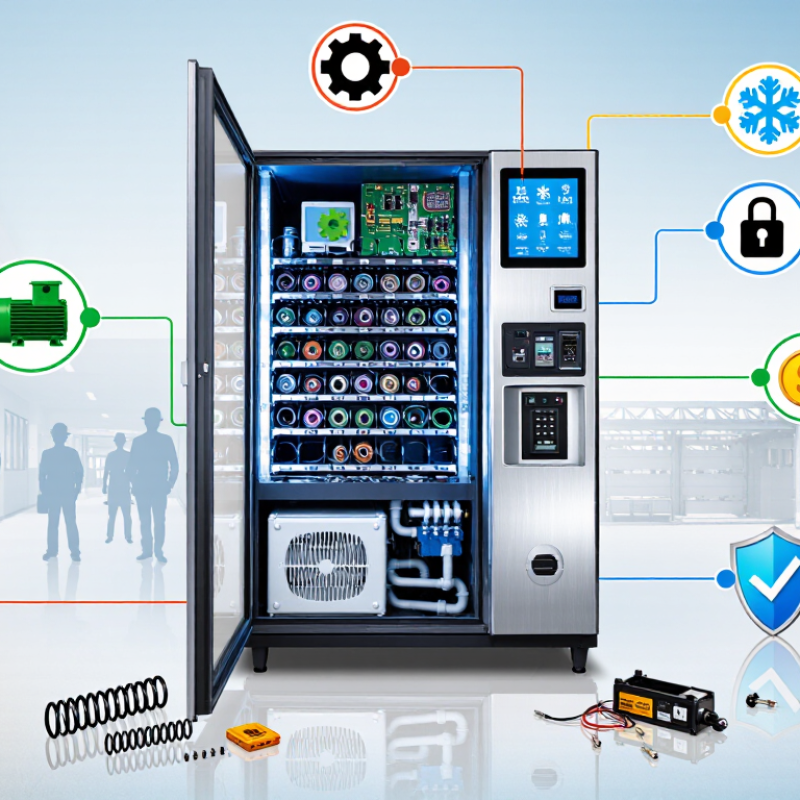
A vending machine works as a small retail system, not a box of separate parts. Each component must support a clear task. The cabinet protects products, wiring, and moving mechanisms from dust and accidental impact. The control board acts as the decision center. It receives payment signals, checks stock data, and commands the dispensing motor. A bright display should show prices, product choices, and error messages clearly.
The payment module verifies approved transactions and sends confirmation to the controller. It must handle incomplete payments without releasing a product. Selection buttons or a touchscreen provide the customer interface. Sensors then confirm whether a product has dropped correctly. This detail matters. A motor may run, but the spiral could still leave the item stuck. The delivery door needs a simple, secure design that reduces product loss.
Motors, spirals, belts, and trays form the dispensing system. Their roles should match product size, weight, and packaging shape. Refrigeration components maintain stable temperatures for products requiring controlled storage. Fans distribute cool air, while temperature sensors help prevent unsafe fluctuations. The power supply supports every function and should include protection against overloads. During machine testing, I would check jam recovery, sensor accuracy, and restocking access. I once underestimated tray alignment; a small angle caused repeated failures. That mistake showed me that component selection requires observation, not only specifications. Good choices come from field testing, maintenance records, and clear operating conditions.
How to Choose Vending Machine Components? - Define the Role of Each Vending Machine Component
| Component | Primary Role | Key Selection Dimensions | Typical Data or Range | Practical Selection Guidance |
|---|---|---|---|---|
| Cabinet and Frame | Supports the internal components and protects products from impact, dust, and unauthorized access. | Installation space, structural strength, insulation, corrosion resistance, service access, and security. | Common indoor machine height: approximately 1.7–2.0 m; depth often 0.7–1.0 m. | Confirm doorway clearance, floor loading, ventilation space, and whether front or rear servicing is required. |
| Product Shelves and Lanes | Organize products and guide each item toward the dispensing mechanism. | Product dimensions, weight, packaging shape, adjustable spacing, and capacity. | Spiral or lane pitch must be matched to the product width; shelf capacity varies by product size. | Use adjustable lanes for mixed product sizes and verify that flexible packaging will not become trapped. |
| Refrigeration System | Maintains a controlled temperature for chilled food and beverages. | Required temperature, ambient conditions, cooling capacity, energy use, noise, and refrigerant type. | Chilled product cabinets commonly operate around 2–8 °C, subject to product and local requirements. | Select a system with sufficient capacity for the cabinet volume, door-opening frequency, and highest expected ambient temperature. |
| Compressor, Condenser, and Evaporator | Transfer heat from inside the cabinet to the surrounding environment. | Cooling load, airflow, operating temperature, maintenance access, efficiency, and acoustic level. | Performance depends on cabinet volume, insulation, ambient temperature, and desired pull-down time. | Provide adequate clearance around the condenser and keep filters and air passages accessible for cleaning. |
| Temperature Sensor and Controller | Measures cabinet temperature and controls the refrigeration cycle. | Measurement range, accuracy, response time, alarm functions, calibration, and control compatibility. | Digital sensors commonly provide accuracy within approximately ±0.5–1.0 °C, depending on the sensor and system. | Place the sensor where it represents product temperature rather than direct airflow from the evaporator. |
| Dispensing Mechanism | Releases the selected product after payment authorization. | Product type, weight, package shape, motor torque, jam resistance, and recovery after failed delivery. | Spiral, conveyor, elevator, belt, and locker-style mechanisms are used for different product categories. | Choose a mechanism based on product geometry and fragility; test the heaviest, lightest, and most irregular packages. |
| Delivery Sensor | Confirms that the product has reached the collection compartment. | Detection method, sensor position, response time, resistance to ambient light, and false-detection rate. | Optical, infrared, weight, or position sensors may be used depending on the delivery design. | Include a delivery confirmation function to reduce incorrect refunds and customer disputes. |
| Payment Module | Accepts and validates the payment method selected by the customer. | Supported payment types, transaction security, refund handling, connectivity, and local regulatory requirements. | Possible methods include coins, banknotes, contactless cards, chip cards, and mobile payments. | Select payment options according to customer habits, transaction value, network availability, and service costs. |
| Main Control Board | Coordinates payment, motors, sensors, display functions, alarms, and transaction records. | Input and output ports, processing capacity, software compatibility, fault logging, and upgradeability. | A suitable controller should support all connected motors, sensors, payment devices, and communication interfaces. | Prefer modular designs with clear diagnostics and replaceable control boards to reduce service downtime. |
| User Interface and Display | Shows product information, prices, instructions, payment status, and error messages. | Screen size, brightness, touch capability, readability, language support, and vandal resistance. | High-brightness displays are preferable in direct sunlight; physical buttons can improve accessibility and reliability. | Use clear prompts, high contrast, and simple navigation to reduce transaction time and user errors. |
| Power Supply and Protection | Converts and distributes electrical power to the controller, refrigeration system, motors, lighting, and payment devices. | Input voltage, total load, peak starting current, grounding, surge protection, and electrical certification. | Supply requirements must match the installation location; refrigeration compressors may draw higher starting current than their running current. | Allow safety margin above the calculated continuous load and use suitable circuit protection. |
| Motors and Gearboxes | Drive spirals, conveyors, elevators, doors, and other moving mechanisms. | Torque, speed, duty cycle, noise, voltage, overload protection, and replacement availability. | Required torque depends on product weight, friction, mechanism geometry, and starting conditions. | Use torque headroom and limit switches or position feedback where a stalled mechanism could damage products. |
| Door Lock and Security System | Prevents unauthorized access to products, cash, electronics, and service areas. | Lock strength, tamper detection, key management, service access, and resistance to forced entry. | Security design should cover the product door, cash area, control compartment, and external communication ports. | Separate customer access from technician access and log unauthorized door-opening events when possible. |
| Lighting System | Improves product visibility and helps customers use the machine in low-light environments. | Brightness, energy consumption, heat generation, service life, color rendering, and moisture resistance. | LED lighting generally uses less energy and produces less heat than traditional fluorescent lighting. | Use even illumination without glare, especially around the product display and payment area. |
| Telemetry and Communication Module | Transmits sales, inventory, temperature, payment, and fault information to an operating platform. | Network coverage, data security, protocol compatibility, remote updates, power use, and offline operation. | Cellular, Wi-Fi, Ethernet, or short-range communication may be used depending on the site. | Choose a module that stores transactions during network outages and sends alerts when connectivity returns. |
| Collection Compartment | Provides a secure and accessible area for the customer to retrieve the dispensed product. | Opening size, product protection, accessibility, hygiene, anti-reach design, and drainage. | The opening should accommodate the largest intended product while limiting access to the storage area. | Use rounded, easy-to-clean surfaces and protect fragile products from excessive drop height. |
| Maintenance and Diagnostic Features | Reduce downtime by helping technicians identify, access, and replace failed parts. | Error codes, component accessibility, spare-part availability, cleaning requirements, and preventive maintenance intervals. | Common service tasks include cleaning sensors, checking motors, inspecting seals, and removing dust from cooling components. | Prioritize standardized connectors, clear diagnostics, tool-accessible panels, and readily replaceable wear parts. |
Related Posts
-

Essential Checklist for Selecting the Right Vending Machine Coin System
-
2026 Best Vending Machine Components for Global Buyers?
-
10 Best Vending Machine Components for Global Buyers
-

Maximizing Profits: A Comprehensive Guide to Selecting the Best Vending Coin Machines for Your Business
-

2025 Top Vending Coin Machines: Features, Benefits, and Best Picks
-

Maximizing Your Investment: The Cost-Effectiveness of Vending Coin Machine Maintenance and Support Strategies